Sunday, August 18, 2013

Do As I Say, Not As I Drive


This reader's Grandpa preached perfect driving to his grandchildren, but it turns out his own record wasn't spotless.


Ford Crestliner
My grandfather liked to brag to his grandchildren about his impeccable driving record. He often warned us to look both ways twice before crossing the street. Not all drivers were as careful as he.
Still, I remember him winking at my grandma as he spoke about his driving skills. It made me wonder.
When the time came for Grandpa to teach me how to drive, I was afraid I wouldn’t live up to his expectations. Yet he was patient and showed me how to drive with confidence on forgiving country roads. His firm reminders kept me from developing a lead foot.

Many years later I became the official family historian. I wanted to learn more about my grandfather’s years of service in World War 2 and my grandparents’ wedding day in 1953. So I searched local newspapers for stories about him on findmypast.com, an online database of public records and newspaper articles.

Under a newspaper listing called “Municipal Court,” I found his name, Gordon Collins Hertz. I was shocked to learn that in 1957 he was fined $5 for rolling through a stop light in his Ford Crestliner.
Of course, I never told him of my discovery. While I would never tell a lie, I must protect even the not so innocent.

Jacob Miller • Ames, IA

Source: Reminise


Newlywed's 1937 Ford scaled “Mount Honeymoon”


Newlyweds got to their cabin on a hill in the San Bernardino Mountains by gunning their 1937 Model T Ford.


3
undefined
RING-A-DING. Betty Tierney had this picture taken to show off her wedding ring, but her 1937 Ford showed up better.
I’ll never forget my 60-horsepower 1937 Ford. It was long on looks and short on power.
After my sailor sweetheart and I were married in a beautiful home cer­emony, we bundled into the car and headed for our honeymoon cabin in the San Bernardino Mountains with a “Just Married” sign on the back and tin cans tied to the bumper. Following a rough 100-mile trip, we arrived at the approximate location of our cabin, only to find that no one in the vicinity knew its whereabouts. We gave up and pulled off to the side of the road, spending our honeymoon night in the car.
At about 5 a.m., we were awakened by a troop of Boy Scouts, who pounded on the car as they walked by during an early-morning hike. Waking up, we looked out the window and discovered our cabin directly across the road at the top of a steep incline! It was so steep, in fact, that my frustrated husband couldn’t coax our Ford up that hill—even though he gunned the engine again and again. He’d heard that Model Ts could sometimes be backed up steep hills, but that trick didn’t work either.
By this time, people in the other cabins had been awakened by the roar of the motor and were out on their porches watching. In desperation, we drove back up the road, turned the car around, came racing down and swerved into the driveway. The car just barely inched its way over the crest of the incline and coasted into the parking space of our cabin as the other guests applauded wildly!
—Betty Tierney
Santa Cruz, California

Source: Reminise


Classic Cars Crash

Ford Coupes crashed in the 1930s

A grandfather saved this photo from his memorable Ford coupe collision back in the 1930's.


While visiting my daughter’s home, I was taken aback by this photo hanging on her wall. My son-in-law, Terrance Hoppe, told me his grandfather Fredrik Hoppe was the driver of the car on the left in this accident, which took place on May 7, 1930, in Milwaukee. Both cars are Ford coupes.

Source: Reminise

Mustang Pool Table

Source: Internet

Thursday, August 15, 2013

Old Ford Ads And Car Pictures

 Ford's public relations was trying to suggest that the Country Squire was cool for a guy to drive. It actually sold in relatively low numbers. The staged photo has a surreal quality to it. Looks like a Chevy in the background
 Ford marketing pitching the idea of more families owning two cars.
 Three-tone 1955 Mystere.
 X100. Looks like a California custom. Very nice.
 1953 Lincoln XL-500.

 1956 Meteor, basically a Ford in Canadian trim.

 1960 Ford Starliner, Ford's only 2-door hardtop in the Ford lineup.
 1955 Ford cartoon ad.
 Life in the ’50's. When was the last time you went to a drive-in? I wonder if they had another drive-in across town that only allowed Chevys.
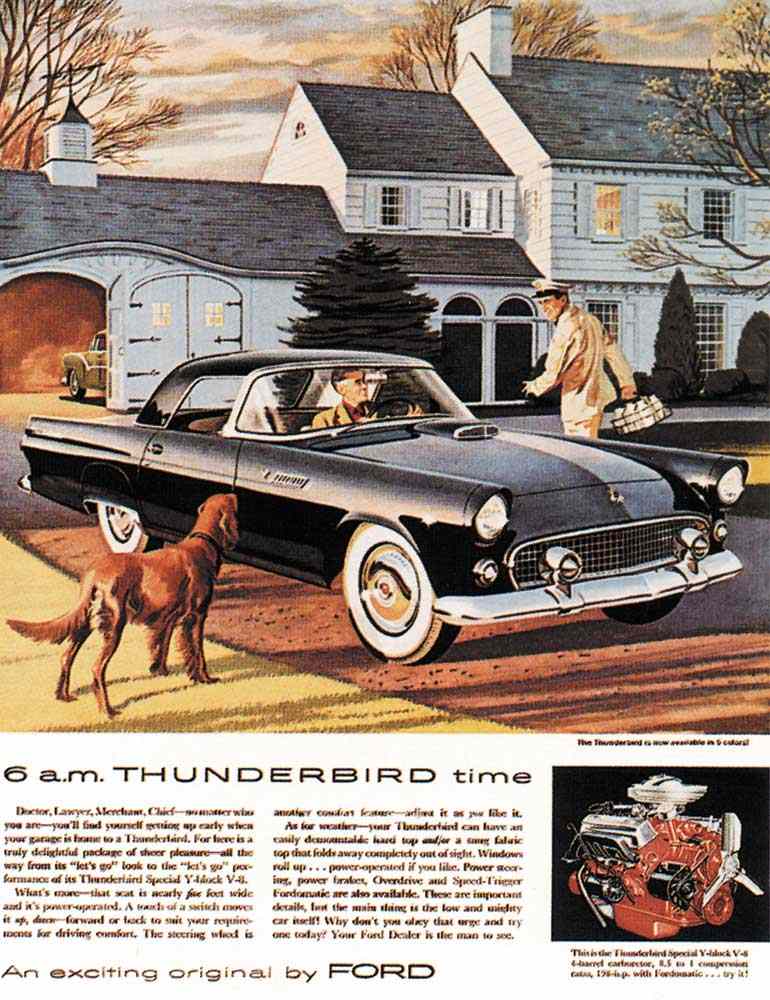
 6 a.m. is Thunderbird time.
 "The magic of the new kind of Ford."
 "The miracle car of this generation."
 International truck ad showing Ford's "global-ness."
George Walker poses with the 1960-X dream car clay model.
 1950 Muroc. Looks kinda narrow.
1959 Galaxie 500 4-door pillarless hardtop with its Thunderbird-inspired roofline.
1956 Victoria. The car's paint scheme matches the house pretty well. Too well.
 1955 Ford Crown Victoria.
1954 Ford Sunliner with continental kit.
Ford Country Squire Wagon.
 
Source: Internet


Tuesday, August 13, 2013

A Lego Ford Explorer

A unique Ford Explorer rolling off the line today at Chicago Assembly Plant will feature the model's its trademark eye-catching craftsmanship with one notable distinction. This Ford Explorer is created from more than 380,000 LEGO bricks and marks the beginning of a long-term alliance between Ford and LEGOLAND® Florida theme park.

You can view a video of the Lego Ford Explorer rolling off the production line here:  Click Here For Video

For more information about Legoland Florida, visit the parks official website at Legoland.com

Source: Youtube

Sunday, August 11, 2013

Ford Mustang

Ford Mustang 1968 Shelby GT-500KR, 1967 GT Fastback, 1966 Coupe, Shelby GT-350

What is your favorite Mustang?

Classic Ford Mustang Cars
The Mustang is undoubtedly one of the all-time classic motor cars and has earned a special place in automobile history standing alone for the influence and impact it has had on the marketplace. Made available with a wide array of “options”, it could be an economical six-cylinder runabout, or a highly competitive performer on the track, it could be a luxury compact or a high specification mile-eater in the true GT tradition. Today the most famous of all ponycars, the Mustang has become highly prized by collectors and its long-term survival looks assured. This guide celebrates nine Mustangs from 1964 – 1968.

1964½ Mustang Convertible

1964½ Mustang Convertible
From the moment of its April 17 1964 introduction at the New York Worlds fair, the Mustang became a standard by which American cars would be judged forever. In the years that followed, sales records were broken and awards for design were given, the Mustang changing the face of the entire automobile industry. By tradition 1964 models normally appeared in September 1963 but as the Mustang was launched mid-year in April, the early cars are referred to as ’64 1/2s. Total 1964 Mustang production was 121,538 vehicles.

1965 Mustang Coupe

1965 Mustang Coupe
Whichever way you look at it, the ’65 Coupe looks more expensive than its original stocker price would have us believe and perhaps this is why it was the hottest selling model of the entire range. When the sixteen moth 1965 model year ended, the Mustang had sold just shy of 681,000 units and the pony-car phenomenon was well and truly underway.

1965 Mustang Fastback

1965 Mustang Fastback
Badged the 2+2, the ’65 Fastback hit the market with a base sticker price of $2,589, although there were enough options to push the price up to nearly $4,000. The 200cid six engine was made standard at the time and cranking out 120 horsepower it gave the 2589lb Mustang a respectable level of performance. Most buyers however chose the optional 289cid V8. In standard form, with two-barrel carburettor, 200bhp was offered, but 225bhp (four barrel) and 271bhp (Hi-Performance) were also available.

1966 Mustang GT Convertible

1966 Mustang GT Convertible
Reluctant to tamper with success, Ford altered the ’66 Mustangs only slightly. Exterior changes were limited to a new horizontal-bar grille and a restyled gas cap, while all but the GT, 2+2 and luxury models got a new side scallop with three wind splits. The GT equipment group required a V8 and included fog lamps, front disc brakes, dual exhausts, handling package and GT racing stripes on the sides.

1966 Shelby Mustang GT-350

1966 Shelby Mustang GT-350
Having created a car with mass appeal, Ford wanted a performance option for the Mustang and for that they turned to the creator of the AC Cobra, Carroll Shelby, who turned the fastback V8 variant of the first Mustang into the fast and rugged Shelby GT-350.

1966 Mustang Coupe

1966 Mustang Coupe
Sales for 1966 could not match 1965 because of the longer 1965 model year, but taking a comparable 12-month period, 1966 sales were actually 50,000 higher. For 1966 Ford picked up close to half a million hardtop sales along with 70,000 convertibles and 35,000 fastbacks.

1967 Mustang GT Fastback

1967 Mustang GT Fastback
Ford knew Chevrolet were developing its own ponycar for ’67, so the Mustang received more extensive changes than it might otherwise have. Styling alterations were obvious yet the flavour of the original was retained. Most noticeable was the larger and more prominent grille and taller separate-element taillights. Setting the headlines though, was the new 390cid four-barrel Thunderbird Special V8 engine option. Rated at 320bhp it offered outstanding acceleration with 0-60mph figures around 7.5 seconds and the standing quarter in 15.5 seconds.

1968 Shelby Mustang GT-500KR

1968 Shelby Mustang GT-500KR
The ’68 Shelby GT-500KR replaced the GT-500 at mid-year, KR of course stood for “King of the Road”. The difference was that a more powerful 428cid Cobra Jet V8 replaced the standard 428. Conservatively rated at 335 horsepower, it actually pumped out about 400 horses. The GT-500KR was considerably quicker than the GT-500 despite the fact that transmissions and rear end ratios were the same. Tested at the time by a leading car magazine the “King of the Road” turned in the quarter-mile in 14 seconds at 102.7mph (Fastback with manual shift).

1968 ½ Mustang GT/CS

1968 ½ Mustang GT/CS
One of the more interesting Mustang offerings in 1968 was the GT/CS. The CS stood for Californian Special and this limited edition model borrowed much of its looks from the mean Shelby GT-350/500s. Features included unique side-striping and side air vents, rear spolier and Shelby-style taillights. A’68 GT/CS could have any engine available in ’68 Mustangs, including the six-cylinder. An estimated 5,000 Californian Specials were produced, and these are avidly sought by collectors today.

Source: Internet